
Unpredictable Patterns #142: Coffee machines, intelligence and interfaces
Why AI may give us the final user interface layer, on coffee machines and UI-drift, interface economies and our role in frictionless intentionality

Dear reader,
After a fantastic week in Munich, I am back on the island. Autumn has now really hit and with the daylight savings time gone the evenings will be long and dark - perfect for reading, writing and learning! This week’s note is an exploration of artificial intelligence as the final user interface. Other writings this week include this piece from the research journal on why agents should be called delegates, and this piece on why governments should be evaluated on how they spend their investigative powers (in Swedish).
Intelligence and the world
Intelligence is a user interface. It is through intelligence that we interact with the world and configure it in ways that help us thrive, survive and learn. When we learn things, we essentially develop new aspects of our user interface that lets us interact with the world in new ways. Our user interface organizes the underlying resources in ways that allow us to create new capabilities and new insights - it offers a way to act.
Today we work with two different user interfaces to the world - the internal ones that are products of study, learning and the acquisition of various mental models, and the external ones that we use to allow us to create complex artifacts like computers. With artificial intelligence, we see the convergence of these two into a single seamless whole - and this will be a greater change than we may realize.
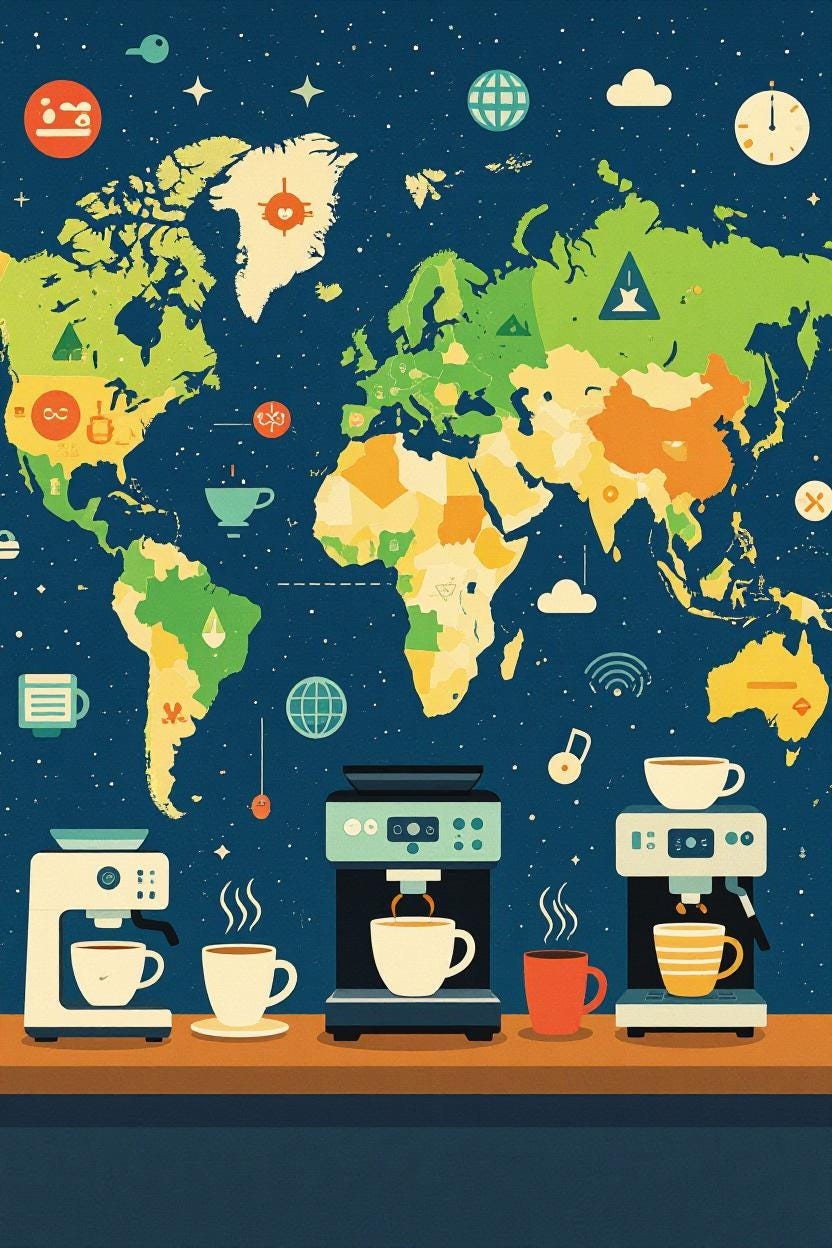
This hybrid mind user interface - our MUI - changes not just our interaction with the world, but further extends us out into the world through all the technology around us. Intention and action become more tightly coupled, and our individual option sets grow fast as more and more of the world is formulated into affordances for us.
What could this look like if we extend the trends a few decades? And what could be going on here? Let’s take a look, and explore the extremes of the trend.
AI and UI
ChatGPT was not built on fundamentally new technology - its strength was rather that it configured existing technologies into a user experience that allowed us to interact with existing technology. The user interface worked in a way that jumped our threshold for assigning intentionality to a system, and suddenly we realized what the underlying technology could do.
This is not meant as criticism or a way to lessen the importance of ChatGPT - rather the opposite: it is a reminder that user interfaces matter much more than we realize. Even the original makers of the interface did not predict that it would take off in the way that it did, highlighting the peculiar fact that we often treat user interface design as a final bolt-on to technology, as a “lesser category” of invention. In reality, it is likely the opposite — all real invention is deeply interface dependent.
We can learn a couple of different things from this. One thing is that when we are trying to predict the next big break through in AI, we would probably do well to try not to look at benchmarks or test of various kinds, but think about user interfaces.
What new user interfaces would really matter?
One obvious example is robotics. When we can interact with AI in a way that allows it to navigate our world, the field changes again - radically. Another example is if we ever manage to build not a “smart home”, but an intelligent one that can interact with everything that makes up a home for us. A third is embodied AI - but not in the form of robots, but implanted in us in ways that allow us to visualize and interact with our health in new ways. A fourth, darker variant, is when weapons systems are made available through intelligent combat systems of various kinds, allowing for the automation of warfare.
All of these different UI-steps are possible future inflection points where the public, policy makers and others will change their view of the technology - for better or worse. Predicting and analyzing them closely allows us to think creatively about possible responses.
Agentic AI is an interesting example of how hard this is - agents present us with a user interface, for sure, but they are also evidence of how difficult it is to build good user interfaces, because all user interfaces suffer from friction. As they interact with the world, they encounter anomalies, delays, glitches and flaws in the world that they were not made to deal with. Adaptive UIs can deal with some of them, but over time all user interfaces decay - not least because they also depend on other user interfaces around them, a brittle ecological constraint.
Good user interfaces force changes in technical ecologies. Web browsers re-organized the way that we offer information and services, and the metaphor of the browser became dominant in the ecology to such a degree that it even outcompeted offline user interfaces like the paper newspaper, and the physical travel agent. Firms re-organized around the metaphors embedded in the user interfaces that emerged with the Internet.
What happened with the browser was that we managed to build a UI that allowed a much broader and more powerful way to interact with the world than we ever had before. The browser became a unified user interface offering up the world as information. Artificial intelligence may well be the next step of that evolution - offering up the world as intention, through a unified dialogue interface (voice, video, text) and organization of skills and capabilities.
In some ways this is not that surprising: we should be able to see that all technology - in Martin Heidegger’s words - is offering up the world as “standing reserve” or as a resource. That this “standing reserve” is becoming broader and deeper over time makes perfect sense. What Heidegger did not predict was that all the technologies offering the world as “standing reserve” would converge into one single interaction surface, a user interface organizing our intentions and interactions with that “standing reserve”.
Interface and cognitive infrastructure
Interfaces and infrastructures are two phases of the same technological life cycle. An interface begins as an experiment in translation — a way for human intention to reach a new domain of capability. Over time, as people grow accustomed to acting through it, the interface ceases to feel like mediation at all. It hardens into background, into the taken-for-granted plumbing of activity and our usage becomes second nature. The keyboard, the browser, the search bar — each began as a visible novelty and ended as an invisible condition for action, intuitively available to us.
The shift from interface to cognitive infrastructure is a measure of adoption but also of dependence. Once a society organizes around an interface, removing it becomes unthinkable. Payment systems, logistics networks, and cloud platforms illustrate this drift: what starts as a convenience becomes a substrate. The interface that succeeds too well disappears; it becomes an environment.
Artificial intelligence is undergoing this same transformation. It begins as a surface of interaction — something we talk to, instruct, or play with — but it is already slipping below awareness, embedding itself in workflows, markets, and institutions. The moment we stop noticing that we are “using” intelligence will be the moment it becomes cognitive infrastructure. What follows is a world where intention travels through a medium so natural it no longer feels artificial at all.
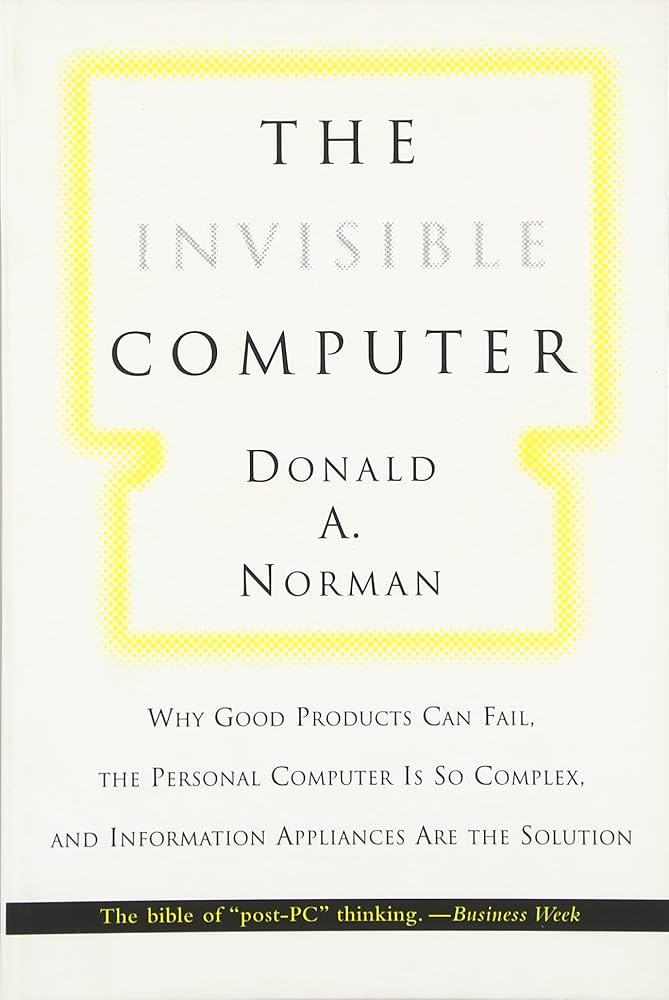
This is the technological evolution predicted by Donald Norman. He argued, in The Invisible Computer, that as technologies mature, they should disappear from conscious attention, becoming seamlessly integrated into the fabric of everyday life. The computer, he claimed, had failed because it forced people to adapt to its logic instead of adapting to theirs. True progress would come when computation became an invisible utility — embedded in appliances, environments, and workflows — serving human goals without demanding technical mediation. In Norman’s vision, the ultimate computer is not a device we notice, but a cognitive infrastructure that quietly amplifies our intentions.
Disintermediation debates return
The web led to a great debate about disintermediation. It seems all but inevitable that this debate now returns with a vengeance. If current trends continue, AI is going to disintermediate the entire web-as-human-browsable in, at most, a decade. Operating systems and apps in computers will be replaced by intelligence as a user interface, more directly channeling our intent into action without forcing us to learn different apps. The pushes into e-commerce where you can pay for products in chatbot interfaces, have the chatbot buy the product and act on your behalf are just the beginning of that trend.
Intelligence will naturally layer on top of any technology that requires that we invest in learning it, or interact with it. It reduces those learning and interaction costs to zero over time.
Exploring this economy allows us to understand user interfaces even better. Any productive act or skill can be modeled with three costs: accessing the resource, interpreting the interface, and executing the action. Over the past century, technology has driven down access and execution costs — the world’s resources are now one click or API call away — but interpretive/interface costs have remained stubbornly high.
Artificial intelligence collapses that final barrier. It turns knowing into doing, reducing the cost of interpretation toward zero. That’s a structural shift: when interpretation disappears, skill markets reorganize, middle layers evaporate, and innovation becomes primarily a function of imagination rather than training in interfaces - at the extremes.
The convergence of user interfaces into a single intelligence layer entail a clear economic logic as well. This logic pushes a new wave of disintermediation that will start with the digital, and it will happen faster than we think - but it will then also expand to the physical world — allowing for interactions with devices and artifacts through intelligence as well.
The ultimate test and signal to be watching could be something like coffee machines.1 In no other class of device do we find so many different, divergent and frankly inexplicable user interfaces. The variety of user interfaces in coffee machines is one of the most blatant examples of evolutionary drift in technical artifacts: designers never have to adapt and converge, because people need coffee and are willing to randomly press, juggle and figure out the interfaces even when they are patently absurd. Each coffee machine encodes a small philosophy of control — some assume you’re a barista, others a supplicant.
Intelligence-as-interface dissolves those microphilosophies into a single shared grammar of intent; in the future there should be none of that useless diversity if user interfaces converge into intelligence. We should instead end up at a Star Trek-like stage where we ask for the drink we want and a device produces it for us, if able.
Now, this does not need to mean that all devices converge too — there may be more expensive and cheaper coffee machines, and there could even be brand competition between them - but ultimately they should all have the same user interface - allowing for seamless translation of intent into hot beverage. (That will leave corkscrews as the final example of wild evolutionary drift in the techno-fitness landscape).
Markets and interfaces
Imagining markets with a single user interface is an interesting thought experiment. It raises questions about how different actors differentiate and compete, as well as questions about what happens to innovation. The optimistic answer is that both will actually improve.
Competition improves when user interfaces allow for competition on the grounds of the quality and scope of the underlying capability: we no longer are locked into the user interface of an operating system when buying a computer or a phone, but can safely focus on the actual capabilities of that phone instead.
This could also drive innovation as devices and services need to compete on the substance rather than form (although design of the individual artifact will still matter — it seems unlikely that all devices converge into a single final device).
The threshold for innovation also is dramatically lowered. Just as the TCP/IP standard and web standards created a single innovative space to explore, with no permission needed, the bubbling up of that unified standard into user interfaces will make it possible to innovate on new skills and capabilities for anyone who has a good idea to try out.
Another way to think about this is to see that markets are actually also interfaces - they allow for the configuration of assets and resources in different ways. A surprising possibility, then, is that markets also converge into a single interface to the economy - mediated by artificial intelligence - and accessible in ways that eliminate large swaths of transaction costs.
This is unlikely to happen fast - since there are built in incentives working to silo markets - but as innovators start to build intelligence layers that span markets, the long term trend will be set.
Why I Could Be Wrong
Best practice when exploring the future is to try to find out what would make me wrong. As we have been exploring this trend in its idealized form, a reality check is overdue. Perhaps this vision of convergence is just fundamentally mistaken. The history of technology is not just a story of consolidation but also of diversification and specialization. When we look closely at successful technological ecosystems, we often find that apparent convergence masks deeper differentiation. The browser did not eliminate all other interfaces — it spawned an explosion of web applications, each with its own interface logic, its own grammar of interaction. Even within a single browser window, we navigate dozens of distinct interface languages daily. Perhaps what appears as convergence toward “intelligence as interface” is actually the proliferation of countless specialized AI interfaces, each optimized for different domains, different levels of control, different relationships to risk and uncertainty. The coffee machine example might be seductive precisely because it’s trivial — but nuclear power plants, surgical robots, and financial trading systems may resist convergence for essential reasons, not incidental ones.
There is also a deeper question about whether humans actually want frictionless translation of intent into action. Friction is not just inefficiency — it is also feedback, learning, and control. When we struggle with an interface, we build mental models of the system beneath it. We develop intuition about its limits, its failure modes, its capabilities. A pilot who can only tell the plane what to do, without understanding how it flies, is not more capable but more vulnerable. The same may be true across domains: doctors who cannot read an X-ray because AI does it for them, programmers who cannot debug because the interface abstracts away the code, strategists who cannot reason about second-order effects because the AI handles complexity. The convergence to a single intelligence interface might not liberate human intention — it might instead create a new form of dependence where we lose the ability to think through our tools rather than just with them. Legibility, not just capability, may matter more than my argument suggests.
Finally, the economic logic of interface convergence may be weaker than it appears. Markets tend toward standards when interoperability creates more value than differentiation — but they resist convergence when lock-in, brand identity, or competitive moats depend on proprietary interfaces. Apple’s entire business model rests on controlling the interface layer, and that model has proven remarkably durable precisely because interfaces are not just translation mechanisms but expressions of values, aesthetics, and relationships. If AI becomes infrastructure, the companies that control it will have every incentive to prevent true convergence, to maintain just enough friction and differentiation to preserve their positions. The unified intelligence interface I describe might founder not on technical limitations but on the stubborn economic fact that those who build interfaces rarely want them to become invisible utilities. The TCP/IP analogy breaks down here: packet routing was solved by cooperation because no one could monetize it well, but intelligence-as-interface is far too valuable to leave as an open standard.
And we?
All of this also has another, perhaps surprising consequence: as the technology eradicates the friction between intention and action, allowing us to interact with the world in more direct ways, the focus should shift back to us. We spoke about two interfaces - our internal and our external - and as of now the focus has been on the external. We have invested billions and plan to invest trillions in artificial intelligence - but that technology is, in our scenario here, limited by our ability to formulate intentions, our curiosity and our ability to explore the world.
Put differently: we have built a technology that can answer any of our questions - but we have not spent as much effort at becoming better at asking those questions.
Asking questions is, I believe, the most important human skill in this world, and we become better at asking questions through the careful acquisitions of subtle mental models from art, fiction, sciences, music - our questions are fuelled by the analogies that the human mind is able to draw between wildly different domains of knowledge.
With the emergence of one final user interface to our technology, our next step, then should be to shift our attention to our own ability to ask the questions that allow us to change and shape the world and its future.
Intelligence without questions is merely mechanism.
Thanks for reading!
Nicklas
For more on this, this doctoral dissertation is a good read: Kuempel, J., 2011. Optimizing the coffee experience by developing a user-centered, internet connected, high precision coffee machine and integrated system experience (Doctoral dissertation, Massachusetts Institute of Technology) p.18-22 studies just a single machine’s interface. See also: Fakfare, P., Rittichainuwat, B., Manosuthi, N. and Wattanacharoensil, W., 2024. Customer service experience for a smart automated coffee vending machine. International Journal of Retail & Distribution Management, 52(7/8), pp.786-800.